How Much Space to Leave Between Furniture and the Wall
The sofa is in, and there is a strip of floor behind it that you are not sure about. Push it back flush, or leave the gap? It depends on which wall it is and what is on it, and getting it wrong can mean a cold room or mould you only find when you move.
 Scooch is an iPhone and iPad appPoint your iPhone camera at the code to install it.
or text me the link
The short answer: it depends on the wall
Against an inside wall with nothing on it, furniture can go flush. There is no rule against it, and the skirting board leaves a small gap anyway. Against an outside wall, the one with the cold on the other side, leave about 10 cm (4 in) behind large pieces like wardrobes, sofas and beds, so air can reach the wall. That is the figure Germany's federal consumer organisation gives, especially for poorly insulated buildings (see Outside walls). In front of a radiator, the advice is not a gap at all: do not put furniture in front of it (see Radiators). A baby should not sleep on an adult bed at all; if a small child could still end up on one, push it tight to the wall with no gap, or leave a full walkway (see Beds).
All you need to check this is a tape measure and a look at what is on the wall: radiators, sockets, switches, vents. The table sums it up.
| Where the piece stands | Gap behind it | Why |
|---|---|---|
| Inside wall, nothing on it | Flush is fine | Inside walls |
| Outside wall | About 10 cm (4 in) | Outside walls |
| In front of a radiator | Do not block it | Radiators |
| In front of a socket | Room for the plug and cable | Sockets |
| Bed a small child could end up on | None, or a full walkway | Beds |
| A path you walk along | 91.5 cm (36 in) | Walking space |
Inside walls: flush is fine
An inside wall has a heated room on both sides, so its surface stays close to room temperature. Pushing a bookcase or a sofa right up to it costs you nothing but the few millimetres the skirting board takes. If the room is small, flush is the way to win floor back: every centimetre a sofa stands off the wall comes out of the walkway in front of it.
Two things to check before you push it back: what is on the wall at the height of the piece (a socket, a switch, a thermostat), and whether the piece is tall enough to tip. Tall pieces should be anchored to the wall (see Tall furniture).
Outside walls: leave about 10 cm
An outside wall is cooler than the room, more so in an older or poorly insulated home. Furniture pushed against it keeps warm room air off that patch of wall, so it gets colder still. Moisture in the air then condenses there, and the risk of mould goes up. That is the mechanism the Verbraucherzentrale, Germany's federal consumer organisation, describes, and its advice is to move larger furniture about ten centimetres away from outside walls and outside corners, or better, to put it against inside walls.
UK guidance agrees on the principle, without a number. The government's guidance on damp and mould in the home lists "low points on walls behind sofas or wardrobes" among the colder places where condensation forms, notes that mould can hide behind furniture, and suggests "leaving a gap between furniture and external walls". Mole Valley District Council's advice puts it plainly: condensation "is also found in areas of little air circulation such as behind wardrobes, beds, and sofas, especially when they are pushed up against external walls".
How to tell an outside wall: it is a wall with the outdoors, or an unheated space, on the other side. In a flat, a wall shared with a neighbour's heated flat behaves more like an inside wall.
Which pieces matter most
The bigger and more closed the piece, the less air gets behind it. A wardrobe or a solid-backed sofa standing flat against an outside wall is the case the guidance is about. A chair on legs, or a shelf with an open back, lets air move behind it anyway. If you are short of floor, put the wardrobes and bookcases on the inside walls and the open, leggy pieces on the outside ones.
Radiators: do not put furniture in front
A radiator needs air to move past it to heat the room. The Verbraucherzentrale's advice is not to cover radiators with panels, furniture or curtains, because only then can the radiator give its full output and the thermostat valve work properly. The City of Hannover explains what happens otherwise: heat builds up behind the furniture, the thermostat valve reads that trapped heat instead of the room, and the room ends up either too warm or still cold.
Neither source gives a safe distance, so the plain reading is: keep the radiator's front clear. If the only wall for the sofa has a radiator on it, try the sofa on a different wall first. UK guidance notes that radiators on outside walls under windows are the position that suits heat distribution, and a window wall is one you would not want to block with tall furniture anyway.
Sockets, switches and cables
A socket behind a sofa needs room for the plug and its cable to come out without being bent flat. Measure how far your plugs stick out, and add a little: that is the minimum gap behind the piece. Do not let the furniture press the cable to the floor or the wall. The Carbondale and Rural Fire Protection District puts it simply: "Do not run cords under rugs or furniture. Cords can become worn, overheat, and cause a fire."
Switches and thermostats matter for a different reason: a wardrobe in front of the only light switch is a layout you live with every evening. Check the height of each one against the height of the piece before you commit.
Beds: no gap, or a real one
For adults, a bed against the wall is a trade: you save a walkway, but one person climbs in from the end or over the other, and making the bed gets harder. If you leave a gap instead, make it wide enough to walk in; the guide to bed sizes and the space around a bed has the widths.
For babies, the in-between gap is the dangerous one. In a 2000 statement, a commissioner of the US Consumer Product Safety Commission counted approximately 271 deaths of children aged five and under since 1990 from entrapment between mattresses on adult-sized beds and walls, and said infants should never be placed on adult beds. If a small child could end up on the bed, do not leave a gap a child could slip into between the mattress and the wall.
Tall furniture: close and anchored
Dressers, bookcases and TVs can tip. The US Consumer Product Safety Commission's Anchor It campaign says that anchoring all furniture with drawers, doors and shelves to the wall prevents tip-over injuries and deaths. Its installation steps are to attach a bracket to the wall, move the furniture close to the wall, attach the other bracket to the furniture, then connect and tighten the strap. That pulls tall pieces back toward the wall, which is one more reason to give them an inside wall and keep the 10 cm gap for the outside ones.
Walking space between furniture and a wall
Sometimes the question is the other gap: the space between a piece and the opposite wall, where you walk. Homes have no legal minimum, but there is a measured benchmark. The US 2010 ADA Standards set a walking surface at 36 inches (915 mm) wide at minimum, allowed to narrow to 32 inches (815 mm) for no more than 24 inches (610 mm) of length, with at least 48 inches (1220 mm) of full width between such narrow spots. Those standards are for public buildings, but a path that wide is wide enough for a wheelchair user, so it is a sound target for the routes you use every day. For gaps inside a seating group, see how much space between a sofa, coffee table and TV.
How to fill the gap between furniture and the wall
Once you have decided a gap should stay, the question is what to do with it. The answer depends on why it is there.
- A 10 cm gap on an outside wall: leave it empty. Its job is to let air reach the wall, so stuffing it with cushions, storage boxes or a panel undoes the point. From the front, a sofa 10 cm off the wall does not read as a gap at all.
- A wider gap behind a sofa that floats in the room: a narrow console or sofa table the height of the sofa back gives you a surface for a lamp and a charger. Pick one with legs and an open frame if the wall behind is an outside one.
- A gap beside a piece, between it and a side wall: a narrow side table, a floor lamp, a plant, or a slim shelf. Measure the gap first, at the floor and at the top, since walls are not always straight.
- The gap you cannot see: a cable tidy along the skirting board keeps cords out from under the furniture (see Sockets).
If the gap is there because the piece is simply too small for the wall, that is a layout question rather than a gap question. How to lay out furniture in a room works through which wall each piece should go on, starting with the doors, radiators and paths.
Plan the gaps before you move anything
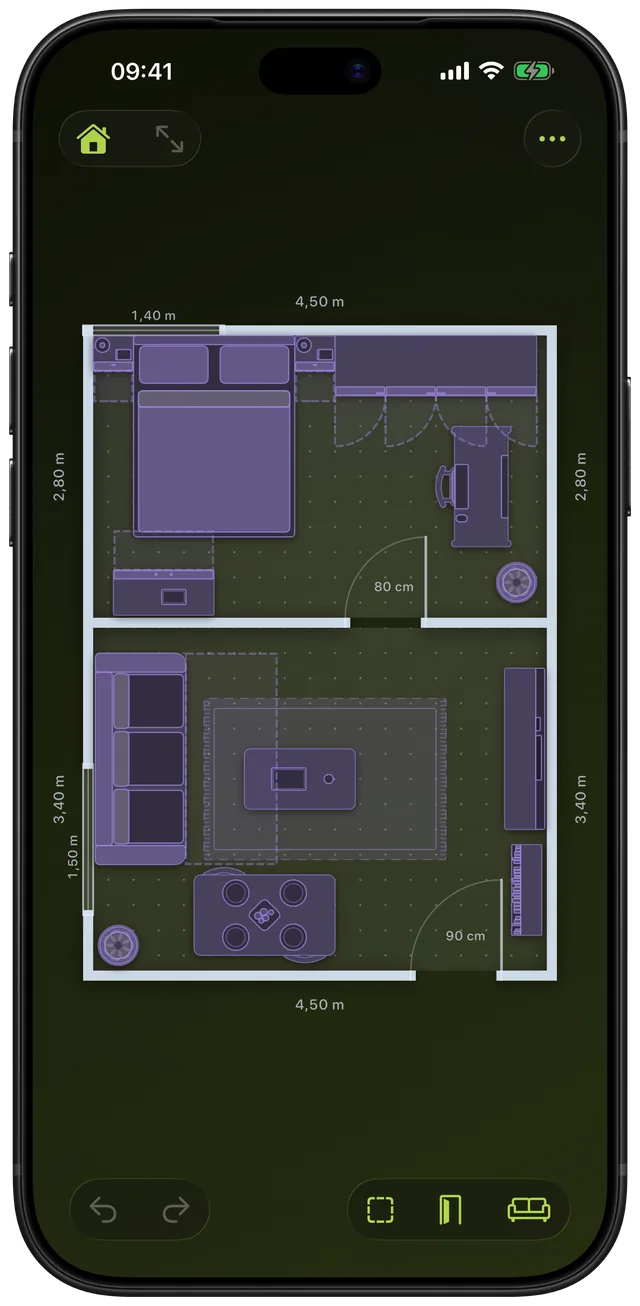
A gap is easy to decide on paper and hard to change once a wardrobe is full. Scooch, a room and floor planner for iPhone and iPad, lets you try it at real size first.
- Draw the room at its measured width and depth. If you have not measured it yet, how to measure a room for furniture covers it.
- Add what is on the walls. Put in the radiator from the catalogue and type its real width and depth. Add sockets, light switches and vents, and slide each one along its wall to where it is.
- Add the furniture and type each piece's width, depth and height from the listing. Dragged near a wall or another piece, it snaps flush to it with a light tick.
- Read the warnings. A piece standing on the radiator overlaps it and is flagged in a warning colour. Tap a socket or switch, and if a piece covers it, the panel says "Blocked by" and names the piece.
- Hold a gap open. To keep a sofa 10 cm off an outside wall, add a Box from the catalogue, set it 10 cm deep, and put it against the wall. Snap the sofa flush to the box, then delete the box. The sofa stays where it snapped.
One honest limit: Scooch flags overlaps, pieces outside the room, blocked sockets and switches, and things in a door's swing. It does not know which of your walls are outside walls, and it does not measure the gap behind a piece for you, so set those gaps yourself as in step 5.
Frequently asked questions
How much space should be between furniture and a wall?
Against an inside wall, none is needed: furniture can stand flush. Against an outside wall, Germany's federal consumer organisation advises moving larger furniture about 10 cm (4 in) away, especially in poorly insulated buildings, so air reaches the wall and the risk of condensation and mould behind the piece goes down. Radiators should not be blocked at all.
Should furniture touch the wall?
It can on an inside wall. On an outside wall, leave a gap so room air can reach the wall surface; UK government guidance names the wall behind sofas and wardrobes as a place condensation forms. Tall pieces that can tip should be anchored to the wall either way, ideally on an inside wall.
How do you fill the gap between furniture and the wall?
If the gap is a 10 cm air gap on an outside wall, leave it empty, because filling it defeats its purpose. A wider gap behind a floating sofa can take a narrow console table with an open frame. A gap beside a piece can take a slim side table, a floor lamp or a plant.
Can a sofa go in front of a radiator?
Consumer energy advice says not to cover radiators with furniture, panels or curtains. Heat builds up behind the sofa, the radiator cannot give its full output, and the thermostat valve reads the trapped heat instead of the room. If the only wall for the sofa has a radiator on it, try another wall.
How much space between furniture to walk?
Homes have no legal minimum. As a measured benchmark, the US ADA Standards set a walking surface at 36 inches (915 mm) wide, narrowing to 32 inches (815 mm) for no more than 24 inches at a time, with at least 48 inches of full width between narrow spots. A path that wide fits a wheelchair, so it is a sound target for everyday routes.
Is it safe to push a bed against the wall?
For adults, yes, though one person climbs in from the end and making the bed is harder. For babies, a gap between the mattress and the wall is a known entrapment hazard, and the US Consumer Product Safety Commission has said infants should never be placed on adult beds.
Sources
- Verbraucherzentrale Bundesverband: Gesundes Raumklima (furniture 10 cm from outside walls; do not cover radiators)
- GOV.UK: Understanding and addressing the health risks of damp and mould in the home
- Mole Valley District Council: Preventing condensation and mould growing in your home
- Hannover.de: Einrichtungstipps (heat build-up behind furniture and the thermostat valve)
- U.S. CPSC (2000): statement on entrapment between mattresses and walls
- U.S. CPSC: Anchor It!
- U.S. Access Board: 2010 ADA Standards for Accessible Design (403.5.1)
- Carbondale and Rural Fire Protection District: Electrical safety